
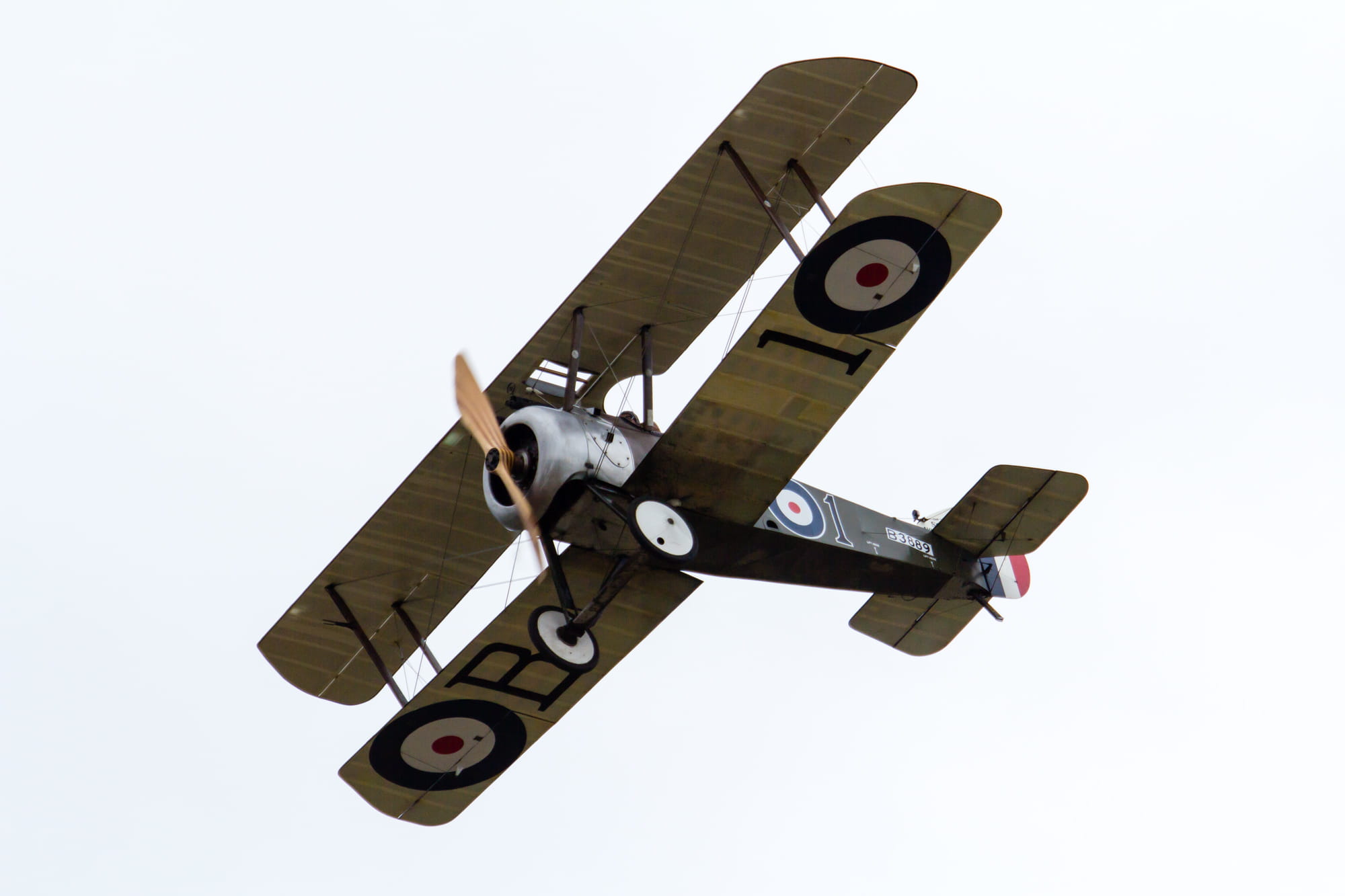
What the Sopwith Camel Teaches the Business That's Growing — but Still Fighting on Outdated Kit
You're past the worst of it. The business survived its first couple of years, you've got a few staff now, and the phone rings without you having to chase every call. By most measures, you're winning. And yet it feels harder than it should. You're working flat out, competing mostly on price, and watching newer or slicker rivals make it look effortless. If that's you, this one's written with you in mind.
In the First World War, the Sopwith Camel was the most successful fighter the Allies put in the sky — its pilots were credited with downing more enemy aircraft than any other Allied type. But it earned that record while being, by the standards of the day, a brute to fly. The story of the Camel and the people who kept it flying is a surprisingly good mirror for the growth-phase business owner: skilled, battle-hardened, and getting results — often despite the equipment, not because of it.
You're No Longer Alone — You Have a Ground Crew Now
In the pioneer phase, it was just you and maybe a partner. That's changed. You've got people. And so did the Camel pilot — far more than most people realise.
The pilot got the glory, but he never touched a spanner. Behind each aircraft stood a team of riggers (airframe), fitters and mechanics (engine), armourers, and transport crew. Based on Royal Flying Corps squadron records, a squadron of roughly twelve aircraft was supported by well over a hundred ground staff — which works out to approximately eight or more ground crew keeping a single aeroplane in the fight. The man in the cockpit was the visible one. The result depended on everyone behind him.
Sound familiar? The coffee shop owner now has baristas and floor staff. The plumber has three vans on the road and spends his days coordinating from an office rather than under a sink. You've gone from doing the work to running the operation — and that's a genuine milestone. But it brings a new problem the pioneer phase never had: now the whole crew is only as good as the systems you give them to work with.
The Dogfight to the Bottom
Here's where it gets painful, and there's no kind way to dress it up. Many growing businesses end up competing almost entirely on price. You drop your quote to win the job. The competitor drops theirs. You drop again. Everyone's margins get thinner, everyone works harder for less, and the customer learns to expect the lowest number on the page.
That's a dogfight — and a dogfight is exhausting and dangerous by design. WWI air combat was close, low, and chaotic, a fight where the slightest disadvantage got you beaten. When the only thing you can compete on is price, you're in a turning fight you can't win for long. There's always someone willing to go cheaper, usually someone who hasn't yet worked out what it really costs them.
The frustrating part is that this rarely happens because your work is poor. It happens because, from the outside, there's nothing else for a customer to judge you on. No visible reputation. No online presence, or one that's years out of date. Nothing that signals you're the experienced operator and not the cheapest gamble. So the conversation defaults to price, and you get dragged into the dive with everyone else.
Skilled Pilot, Dated Aircraft
The Camel kept winning because of the calibre of the pilots flying it. But the aircraft itself was unforgiving — famously hard to handle, and it punished anyone who hadn't mastered its quirks. By late in the war, newer designs were catching up, and the Camel started to lose its edge. The skill in the cockpit was carrying equipment that was being overtaken.
This is the quiet reality for a lot of established small businesses. The owner is excellent at the actual trade — years of hard-won skill. But the business is being flown on dated kit: paper diaries, a booking system that's really just a shared phone, quotes typed out by hand each time, invoices chased manually, customer details scattered across notebooks and one overworked memory.
It works, in the sense that you're still airborne. But it's costing you in ways that don't show up on a single invoice: hours lost to admin, jobs that slip through the cracks, double-bookings, slow follow-ups, and the constant low hum of everything depending on you personally. Meanwhile a competitor with a fraction of your skill but a tidy modern setup looks more professional to a customer who can't see the difference in workmanship — only the difference in presentation.
None of this is a character flaw. You built systems that fit the business when it was smaller, and you've been too busy flying to re-equip. That's not negligence — that's just what happens when you're in the fight every single day.
The Same Skill, Better Equipped
The encouraging part of the comparison is this: the pilot was never the problem. Give that same experienced pilot a better-handling aircraft, and the skill that kept an unforgiving machine in the air becomes genuinely hard to beat.
The growth-phase business has the same opportunity, and it doesn't require becoming a different person or chasing every shiny tool. It means letting your hard-won skill be carried by equipment that's worthy of it. A real booking or job-management system instead of a shared diary. Quotes and invoices that go out in minutes, not evenings. A current, credible online presence so customers can see who you are before price ever enters the conversation. The goal isn't more technology for its own sake — it's to stop competing on price alone and start competing on the thing you're actually good at.
That's how you climb out of the dive. Not by going cheaper, but by giving customers a reason to choose you that has nothing to do with being the lowest number on the page. The better-equipped operator gets to fight on their own terms.
You've Already Done the Hard Part
If you recognise yourself in this — skilled, busy, growing, but quietly worn down by competing on price with tools that haven't kept pace — take some reassurance from it. The hardest phase is behind you. You've proven the business works and you've built a crew around it. What's left is an equipment problem, and equipment problems are the most fixable kind.
The pilots who came home weren't always the ones with the best aircraft. But the ones with both skill and the right machine were the ones who got to choose how the fight went. After years in the air, you've more than earned the right to fly something better.
We spend our days helping established small businesses re-equip for the fight they're actually in — the digital side especially. If you ever want a hand getting your systems and online presence up to the standard of your work, Blue Pilot Agency is here.